I am not writing this text lightly.
And I am not writing it to complain, seek sympathy, or defend myself.
I am writing it because from the very beginning I said that truth and transparency are the foundation of this project. And now the moment has come when that truth can no longer be simplified or softened without ceasing to be truthful.
All along I said that the boat project was not just a dream.
It was a dream – yes.
But above all, it was a last hope.
To understand what it was a last hope for, I need to describe the reality in which this project was created.
The context in which the project was born
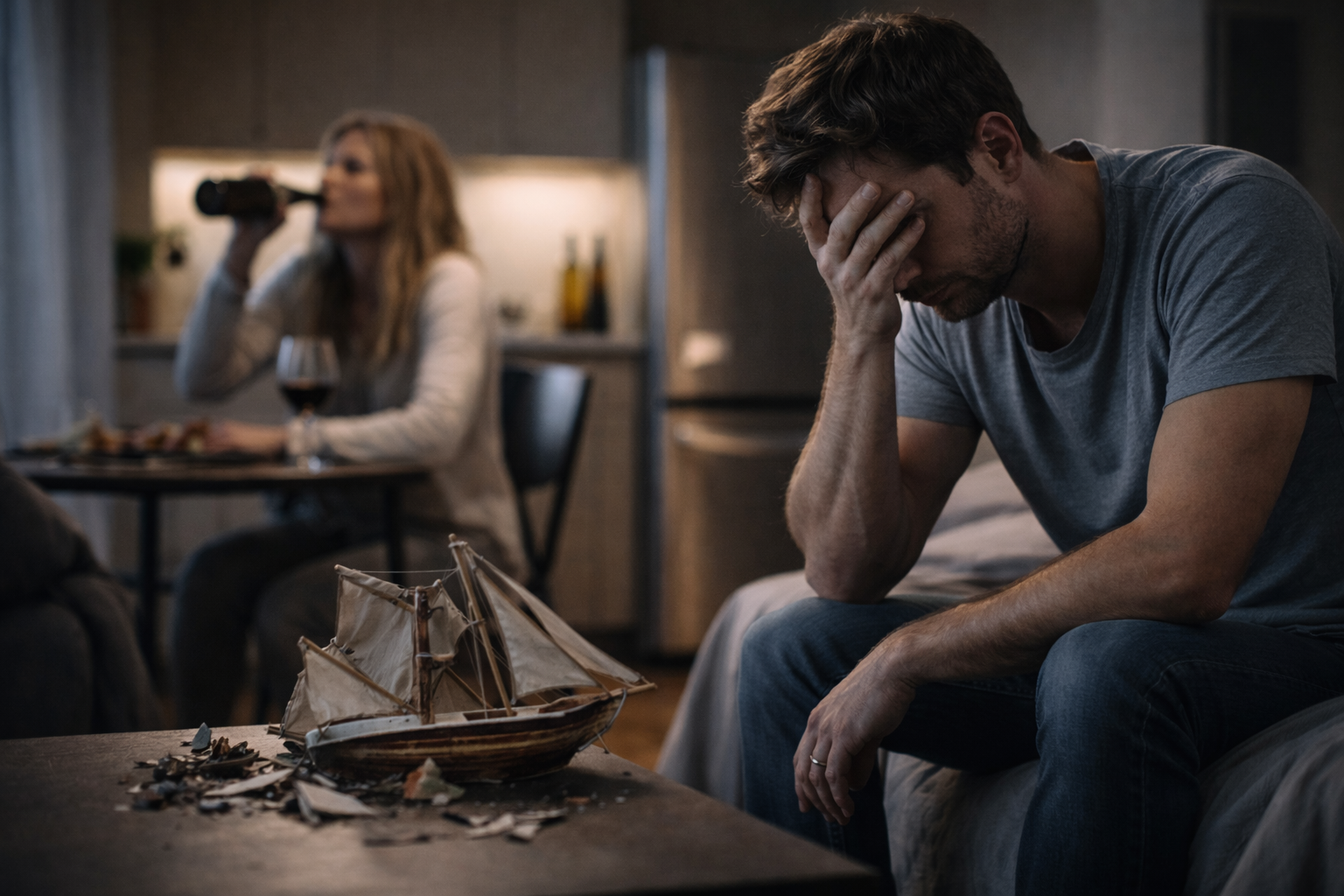
For a long time, I lived in a relationship burdened by a serious alcohol problem on the part of my partner.
This was not a short episode, a temporary crisis, or a fluctuation.
It was a long-term condition that gradually worsened and began to define our everyday life.
I myself do not struggle with alcohol.
On the contrary, for a long time I tried to cope with the situation, manage it, and find solutions, often at the expense of my own peace of mind and mental health.
For a long time, I believed that a moment would come when the problem would finally be addressed openly, responsibly, and with a real willingness to change.
That moment never came.
What I mean by a “problem with alcohol”
It is important to be absolutely clear here so there can be no doubt or misinterpretation.
When I speak about a problem with alcohol, I am not speaking about myself.
I am speaking about my partner’s alcoholism.
And I am not referring to:
-
a glass of wine on the weekend
-
occasional drinking
-
a so-called “Mediterranean lifestyle”
-
or someone “having one night too many”
I am referring to long-term alcoholism that gradually worsened over the years until it became a daily reality.
In the last months, this meant daily drinking, typically at least 0.7 liters of wine every day, with no breaks and no “dry days”.
This is not an emotional interpretation.
It is a factual description of the situation I lived in as a partner.
Attempts to resolve the situation
I did not ignore the problem. I repeatedly tried to address it through calm, open conversations. Not arguments, not accusations, but a clear acknowledgment of the situation and an attempt to find a solution.
My partner’s reactions followed the same pattern:
-
denial of the severity of the problem
-
defensive and often aggressive responses
-
immediate shifting of blame onto me (“BUT YOU…”)
-
avoidance of any concrete steps
Approximately 2–3 months ago, I was given a promise that the situation would finally be addressed.
I took that promise seriously and gave time and space.
During that entire period, nothing happened:
-
no doctor
-
no therapy
-
no plan
-
not a single concrete step
The breakdown of everyday life together
Around the same time, our relationship effectively stopped functioning.
For several months now, we have not slept together. I sleep separately, on the couch.
Not as a gesture, not as punishment, but as a direct consequence of a reality that had become unlivable.
Even this situation – which in itself represents the end of normal partnership life – did not lead to any effort to change on my partner’s side.
It was not a wake-up call.
It was not a turning point.
Life simply continued the same way.
The long-term pressure
Living long-term next to someone with an addiction means:
-
constant tension
-
walking on eggshells
-
weighing every word
-
knowing that any attempt at openness will end in conflict
This is not a short-term crisis.
This is a state that slowly but steadily destroys the mental well-being of the person who does not have the addiction, but has to live with it.
Why the idea of the boat emerged
It was in this context that the idea of the boat emerged.
Not as an escape.
Not as a romantic fantasy.
But as a last attempt to change the conditions in which the addiction existed.
I genuinely believed that:
-
limited access to alcohol
-
a complete change of environment
-
a shared goal and daily structure
could create space where the problem would finally begin to be addressed, rather than denied.
It was hope. Not certainty.
Why I now know it was not enough
Today it is clear that:
-
addiction cannot be solved by changing location
-
addiction cannot be solved by a project
-
addiction cannot be solved by the hope of a partner
If the person with the addiction does not want to start addressing it themselves, no boat, no ocean, and no isolation will do it for them.
Why it is no longer possible
Today, the situation is such that:
-
daily drinking continues
-
reactions to any confrontation are aggressive
-
promises remain empty
-
the psychological pressure is no longer sustainable
This is no longer something that can be “endured a little longer.”
This is not a phase.
This is a state with no movement in the right direction.
Why I am writing this publicly
I am writing this because I have always built this project on truth and transparency.
I do not want there to be any impression that “a problem with alcohol” means that I drink.
I do not.
I am describing the reality I lived in as the partner of someone with an addiction, and that reality was the main reason why the boat became more than a dream – it became a last hope.
That hope turned out to be misplaced.
Admitting that is painful, but necessary.
Sometimes the strongest decision is not to endure.
Sometimes the strongest decision is to stop denying reality.
Final words
There is one thing that is extremely difficult to put into words.
It is incredibly painful to watch someone you love slowly destroy themselves.
Even more painful is the moment when you are forced to admit that you do not have the power to change it.
People struggling with addiction will always find a reason why they need to drink.
Stress. Fatigue. Emotions. Life itself.
The reason changes — the drinking does not.
You know that your partner loves you.
You can feel it. You can see it in moments of clarity.
But you also come to understand one brutal truth:
Alcohol is loved above everything else.
And when a real decision has to be made —
between a person who stands beside them
and a bottle —
the bottle always wins.
Not because you were not enough.
Not because you failed.
But because addiction does not negotiate.
And there is nothing you can do about it.
The only real choice left is to walk away.
To stop enabling.
To stop hoping that love alone will be stronger than addiction.
Either the person drinks themselves into destruction,
or — in rare cases — they are forced to face reality, usually only when external pressure appears, such as a legal or medical intervention.
Walking away is not abandonment.
It is not cruelty.
It is not a lack of love.
Sometimes it is the only remaining act of self-preservation.
And sometimes, the hardest truth to accept is this:
You can love someone deeply —
and still be powerless to save them.